
MODULE 1: OSHA 10 TRAINING
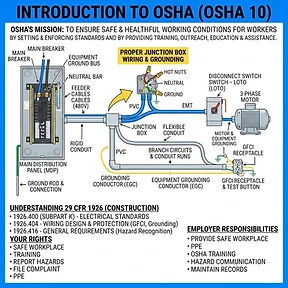
FIG · 29 CFR 1926, 90.1
Introduction to OSHA (OSHA 10)
This lesson provides an in-depth study of OSHA regulations, worker rights, and construction safety standards under 29 CFR 1926.
YOUR PROGRESS
REAL-TIME METRICS0% complete
0 of 6 done
Not attempted yet
Learning objectives
- Identify the core legal requirements for employers under the OSH Act of 1970.
- Distinguish between the roles and legal definitions of a competent person and a qualified person.
- Apply the hierarchy of hazard controls to common electrical construction site risks.
- Summarize the legal procedures for reporting unsafe work conditions without fear of retaliation.
- Categorize the levels of OSHA inspection priorities and the enforcement process.
- Evaluate specific job site conditions against the mandates of 29 CFR 1926 for regulatory compliance.
Why this matters in the field
Electrical construction is inherently high-risk, involving invisible hazards like energized conductors and stored mechanical energy. OSHA regulations are not merely bureaucratic hurdles; they are the distillation of lessons learned from thousands of workplace fatalities. Understanding the law is the first line of defense in maintaining a safe work environment.
When a job site operates in violation of OSHA standards, the cost extends far beyond the financial burden of fines or project shutdowns. It costs people their livelihoods and their lives. A simple oversight in grounding or a failure to implement proper lockout/tagout procedures can trigger a catastrophic arc flash, leaving a legacy of tragedy that can never be undone.
By mastering 29 CFR 1926, you shift your role from a participant in the hazard to a professional who identifies, controls, and mitigates risk. This knowledge protects you from employer negligence, guides your decision-making on site, and ensures you have the authority to halt unsafe work before an incident occurs. Compliance is the foundation of a sustainable career in the electrical trade.
Core concepts
The Hierarchy of Controls
The OSHA framework relies on the hierarchy of hazard controls to manage workplace safety. This is a prioritized sequence of interventions starting with the most effective method: elimination. Elimination involves physically removing the hazard, such as de-energizing a circuit completely. If elimination is impossible, we move to substitution, replacing the hazard with something safer, such as using a low-voltage control system. Engineering controls, such as installing GFCI breakers or physical barriers, come next. Administrative controls, like safety signage and job rotations, rely on human behavior. Personal Protective Equipment (PPE) is the final and least reliable defense. Ignorance of this hierarchy leads to over-reliance on PPE, which is prone to failure and human error. When an employer skips engineering controls to save money, they increase the probability of a fatal event.
Qualified vs Competent Persons
OSHA distinguishes between a qualified person and a competent person. A qualified person has training and experience in specific equipment or methods, allowing them to perform tasks such as troubleshooting energized panels. This is demonstrated by knowledge of construction and operation. A competent person, however, is a higher authority defined in 29 CFR 1926.32(f). They can identify existing and predictable hazards and have the legal authorization to stop work or mandate changes immediately. A site foreman acting as a competent person must have the "teeth" to enforce the rules. Failure to designate a competent person for complex tasks like trenching or high-voltage work often results in immediate red-tags from inspectors and increases the risk of preventable site accidents.
Electrical Safety Standards
Under 29 CFR 1926 Subpart K, electrical safety mandates are specific to construction. These rules govern temporary power, grounding, and flexible cords. The principle is that all electrical installations must be designed to minimize the risk of shock or fire. This includes the use of properly rated equipment, maintaining clear working space, and ensuring the integrity of grounding paths. Unlike permanent installations covered by the NEC, construction site electrical work is transient and subject to significant abuse. When these standards are ignored, the result is usually damaged insulation, compromised grounds, or improper overcurrent protection. This leaves the electrician and other trades vulnerable to fault currents that find paths through their bodies, leading to cardiac arrest or severe electrical burns.
The Inspection Enforcement Loop
OSHA inspections follow a strict protocol designed to protect workers and gather evidence. The inspection cycle begins with an opening conference, transitions to an extensive walkaround, and ends with a closing conference. The process is governed by the OSH Act, which grants OSHA the right to enter and inspect without delay. If the agency finds violations, they issue citations. A key part of this concept is the "Right to Abate." This means the employer must fix the issue within a set timeframe. Ignoring this requirement leads to massive daily penalties. Many field workers fail to understand that they are legally allowed to speak to the inspector privately, which is a vital tool for documenting unsafe practices that management may be hiding.
Code requirements
- 29 CFR 1926.20(b)(1) states that the employer must initiate and maintain a safety program that provides for frequent and regular inspections of the job site by a competent person.
- 29 CFR 1926.403(b)(1) mandates that electrical equipment be free from recognized hazards that are likely to cause death or serious physical harm. This is a catch-all regulation used frequently for unlabeled or improvised wiring.
- 29 CFR 1926.404(b)(1) covers GFCI requirements, stating that all 120-volt, single-phase, 15- and 20-ampere receptacle outlets on construction sites that are not part of the permanent building wiring must have GFCI protection. There are exceptions for assured equipment grounding conductor programs, but these require strict documentation.
- 29 CFR 1926.416(a)(1) forbids working near an electric power circuit unless the circuit is de-energized and grounded, or protected by other means such as insulation or guarding.
- 29 CFR 1926.417 requires that all equipment be locked out and tagged out while maintenance or repairs are being performed.
Step-by-step method
- Confirm the hazard: Identify the electrical or physical danger present.
- Stop and Assess: If there is an imminent danger, use your stop-work authority.
- Identify the Competent Person: Locate the site safety manager or foreman responsible for that specific scope of work.
- Document the Issue: Take photos if safe to do so, note the time, the location, and the specific 29 CFR 1926 section in violation.
- Report the Hazard: Inform your direct supervisor of the violation. If they refuse to fix it, contact the company's safety director.
- File a Formal Complaint: If the hazard remains unaddressed, visit the OSHA website or your local regional office to file a whistleblower or site safety complaint.
- Follow Up: Monitor the site for changes; if retaliation occurs, file a whistleblower claim within 30 days.
Worked examples
- Straightforward: A crew is using temporary 120V power for tools. You notice the extension cords are missing the GFCI box. Per 29 CFR 1926.404, this is a violation. You must immediately disconnect the power and install a portable GFCI device rated for the circuit capacity. Final answer: Restore with GFCI protection before use.
- Derating/Demand: A temporary power distribution board handles four 20A loads at 80% duty cycle. OSHA requirements for equipment rating mandate that we do not overload the service. 20A x 4 x 0.8 = 64A. You must ensure the service feeder is at least 70A rated to comply with the 125% rule for continuous load. Final answer: 70A minimum service capacity required.
- Common Trap: A worker performs maintenance on a disconnect with the breaker locked out but does not test for voltage. Under 29 CFR 1926.417, the process of verifying a "zero energy state" is required. Using a calibrated meter, verify all phases to ground and phase to phase. Final answer: Must verify zero energy using a calibrated meter prior to touching conductors.
Field scenarios
- During a renovation, you find that the main service equipment is missing the dead-front cover. You explain to the general contractor that this violates 29 CFR 1926.403(i)(2) regarding guarding of live parts. The contractor installs a temporary Lexan cover, bringing it back into compliance.
- You are asked to drill through a wall where conduits are suspected to be live. You invoke your authority as a qualified person to request a trace of the circuits and a lockout procedure. The manager agrees, preventing a potential drilling through a live 480V feeder.
- A coworker is fired after reporting that he was asked to work on a 277V lighting circuit without turning off the breaker. He calls you for advice. You help him file a whistleblower complaint with OSHA within the 30-day window, leading to an investigation and his eventual reinstatement.
Common mistakes and inspection failures
- Leaving temporary panels without covers (dead-fronts).
- Failing to document the monthly testing of GFCI devices.
- Using extension cords with damaged insulation (field repairs with tape are not allowed).
- Blocking access to overcurrent protective devices (36-inch clearance rule).
- Allowing unqualified personnel to access high-voltage enclosures.
- Failing to maintain a current, written hazard communication program.
- Missing labeling on temporary power distribution panels.
- Neglecting to provide appropriate PPE for the arc-flash potential of the equipment being serviced.
Safety notes
- Always verify the absence of voltage with a properly calibrated meter.
- Maintain a minimum 36-inch working clearance in front of all electrical equipment.
- Never bypass safety interlocks on power equipment.
- Ensure all tools are double-insulated or properly grounded for the environment.
- Always wear the appropriate PPE, including voltage-rated gloves and arc-rated clothing, before starting work.
Exam tips
- Remember that the "Qualified Person" and "Competent Person" definitions are favorites for testing; know the difference.
- Understand that 29 CFR 1926 takes precedence over general industry standards on construction sites.
- Always look for the "immediate action" answer in situational questions regarding imminent danger.
- Keep in mind that OSHA sets the minimum standards; local jurisdictions can be stricter, but never more lenient.
Key takeaways
- OSHA standards exist to ensure every worker goes home whole at the end of the shift.
- You have the legal right to refuse unsafe work if you have a good-faith belief it creates imminent danger.
- The hierarchy of controls (Elimination, Substitution, Engineering, Administrative, PPE) is the gold standard for hazard mitigation.
- A competent person is legally empowered to stop work when hazards are identified.
- Electrical violations are among the most frequently cited construction safety issues.
- Whistleblower protections exist to ensure you can report hazards without fear of termination.